

Answers to the most common questions about lithium-ion forklift batteries: how they work, how long they last, how they are charged and their benefits compared to lead-acid batteries.
Lithium-ion is a collective term for many different chemistries and technologies. Compared to a lead-acid battery it has a much higher energy density, so it can store and supply energy much faster.
The most common cell chemistries in the truck and car industry are LFP (lithium, iron, phosphate), NMC (nickel, manganese, cobalt) and NCA (nickel, cobalt, aluminium). Toyota uses NCA or NMC cells because of their higher energy density.
Toyota uses cylindrical cells that do not touch each other, which makes them very safe. Safety and quality are Toyota’s core values.
Energy is generated by the movement of free ions between the anode and cathode in the cell. Several cells make up a module, and several modules make up a battery. Each module and the whole system have a battery management system (BMS) that monitors charging and consumption and, in case of damage or overheating, cuts the power and displays an error code.
Lithium-ion batteries are suitable for all truck types. Capacity and size are adapted to driving time and the number of shifts.
Thanks to its high energy density, a lithium-ion battery has up to 30% more usable capacity, so fewer Ah are needed – e.g. 210 Ah Li-ion corresponds to 300 Ah lead-acid. They are also smaller and lighter than lead-acid batteries.
A lithium-ion battery lasts up to 5,000 charges, while a lead-acid battery lasts about 1,500.
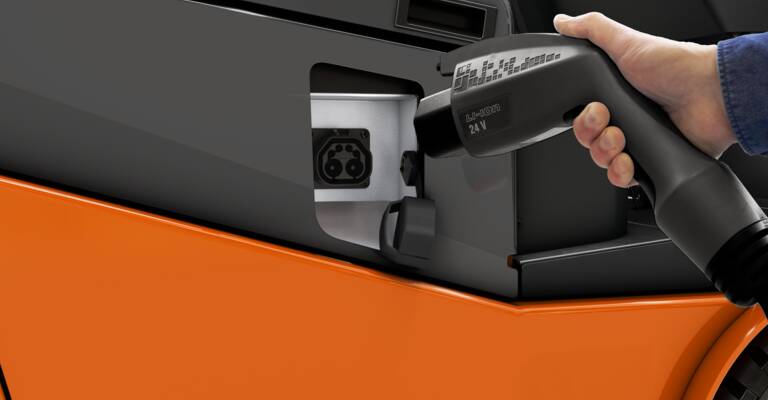
They are charged with dedicated chargers with special connectors, with no risk of short circuits, sparking or gassing. They can be charged anywhere in the building, without the ventilated room and protective equipment required for lead-acid batteries.
Toyota chargers come with dynamic power limiting as standard, which reduces peak loads and energy costs. When several trucks are charging, the one with the emptiest battery gets the most power – this shortens charging and increases efficiency by up to 15%.

From 20% to full capacity in 1–2 hours, depending on the battery and charger size. A 15-minute charge gives at least one hour of driving time. A lead-acid battery takes about 8 hours to fully charge.
Lithium-ion batteries can be charged at any time and at any level without affecting their service life. A 25 V battery fully charges in just 80 minutes, and 50% capacity is reached in 30 minutes, so charging during breaks is quite sufficient.

Maintenance-free batteries for 24-hour operation. Find out more ›
Find the right energy source for your forklift. Find out more ›

Trucks designed around the Li-ion battery. Find out more ›
Our sales team will help you choose the right solution for your business.
Send us an enquiry – we will reply as soon as possible. We process your data confidentially, in accordance with our Privacy policy.
Our 14 mobile service units are available throughout Serbia. For urgent breakdowns call the on-call line; for regular servicing, service packages or thorough examinations, send a request.
On each model page click “Request a quote”, choose the configuration and send your enquiry. You can also write to us via the contact form.
The price depends on the configuration (mast, battery, wheels, equipment), financing and service, so we prepare a tailored quote for every enquiry.
Yes, we offer short-term and long-term rental. Models available for rental have a “Request a rental quote” button. More on the Rental solutions page.
Yes, we service and maintain forklifts of all brands.
Send us the model, the truck serial number and a description of the part via the contact form.
Yes, for all truck types, at our centre or at your site. More on the Operator training page.